


Antwort Why PyTorch is better than Keras? Weitere Antworten – Why use PyTorch instead of Keras

PyTorch vs Keras
Keras also offers more deployment options and easier model export. However, remember that PyTorch is faster than Keras and has better debugging capabilities. Both platforms enjoy sufficient levels of popularity that they offer plenty of learning resources.Key Takeaways. PyTorch vs TensorFlow: Both are powerful frameworks with unique strengths; PyTorch is favored for research and dynamic projects, while TensorFlow excels in large-scale and production environments. Ease of Use: PyTorch offers a more intuitive, Pythonic approach, ideal for beginners and rapid prototyping.PyTorch is favored over other Deep Learning frameworks like TensorFlow and Keras since it uses dynamic computation graphs and is completely Pythonic. It allows scientists, developers, and neural network debuggers to run and test portions of the code in real-time.

Why do researchers prefer PyTorch : It offers an intuitive and dynamic approach to building neural networks, making it an ideal choice for deep learning experiments and prototyping. Unlike some other frameworks like TensorFlow, PyTorch has a reputation for keeping things simple yet powerful. Though TensorFlow is undoubtedly powerful, it is buggy.
Why does Tesla use PyTorch
Tesla uses PyTorch for Autopilot, their self-driving technology. The company uses PyTorch to train networks to complete tasks for their computer vision applications, including object detection and depth modeling.
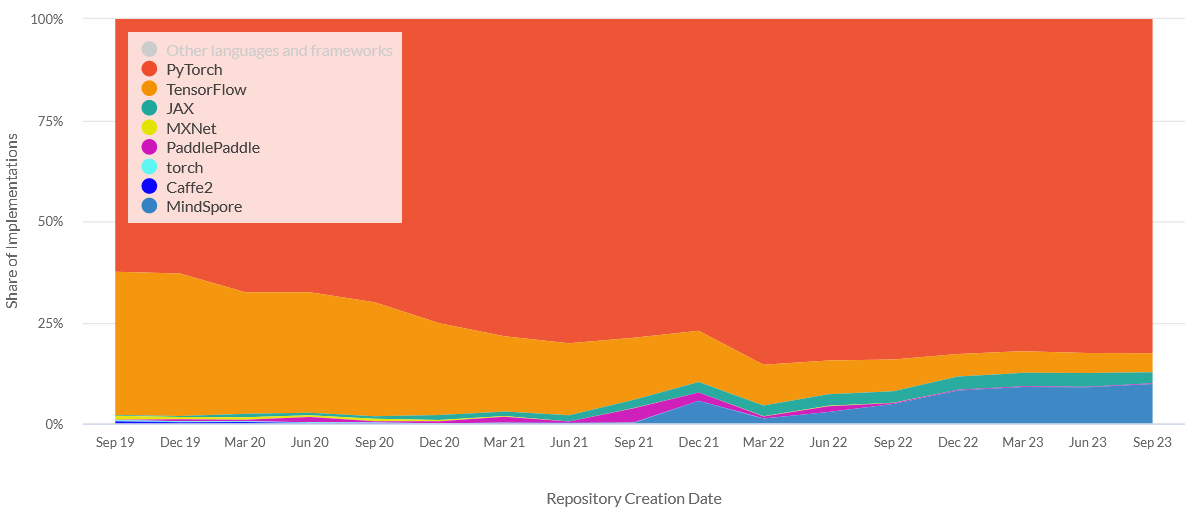
Why is everyone switching to PyTorch : Many people ask me the same question: which of these frameworks should you learn The research community rallied around PyTorch for a good reason: it's much easier to understand than TensorFlow. PyTorch code feels and looks like Python code. TensorFlow 2 is much better, but the first version left a bad aftertaste.
PyTorch has made improvements to support distributed training and scalability. It provides tools to help you train deep learning models on multiple GPUs and even across multiple machines. But TensorFlow still holds the lead in deploying large-scale models in production.
PyTorch Examples and Applications
Due to its strong offering, PyTorch is the go-to framework in research and has many applications in industry. Tesla uses PyTorch for Autopilot, their self-driving technology.
Why does everyone use PyTorch
Providing the benefits of Torch's efficient back-end libraries and Python's intuitive front-end, PyTorch offers user-friendliness, fast prototyping, and a vast community for support, making it popular for use in artificial intelligence applications, including natural language processing and deep learning.While TensorFlow is used in Google search and by Uber, Pytorch powers OpenAI's ChatGPT and Tesla's autopilot. Choosing between these two frameworks is a common challenge for developers. If you're in this position, in this article we'll compare TensorFlow and PyTorch to help you make an informed choice.Does OpenAI use PyTorch or TensorFlow OpenAI uses PyTorch to standardize its deep learning framework as of 2020.

Does OpenAI use PyTorch or TensorFlow OpenAI uses PyTorch to standardize its deep learning framework as of 2020.
Is ChatGPT built on PyTorch : I'll start: – AI research runs on PyTorch. – ChatGPT was built with PyTorch.
Did TensorFlow lose to PyTorch : The research community rallied around PyTorch for a good reason: it's much easier to understand than TensorFlow. PyTorch code feels and looks like Python code. TensorFlow 2 is much better, but the first version left a bad aftertaste.
Is ChatGPT written in PyTorch
ChatGPT is built on top of PyTorch, which provides the core functionality for training and running the GPT-3.5 model.

Tesla uses PyTorch for Autopilot, their self-driving technology. The company uses PyTorch to train networks to complete tasks for their computer vision applications, including object detection and depth modeling.PyTorch has made improvements to support distributed training and scalability. It provides tools to help you train deep learning models on multiple GPUs and even across multiple machines. But TensorFlow still holds the lead in deploying large-scale models in production.
Why is TensorFlow losing popularity : TensorFlow isn't dead. It's just not as popular as it once was. The core reason for this is that many people who use Python for machine learning are switching to PyTorch. But Python is not the only language out there for machine learning.