


Antwort What spectrum is visible light? Weitere Antworten – What is the visible light spectrum

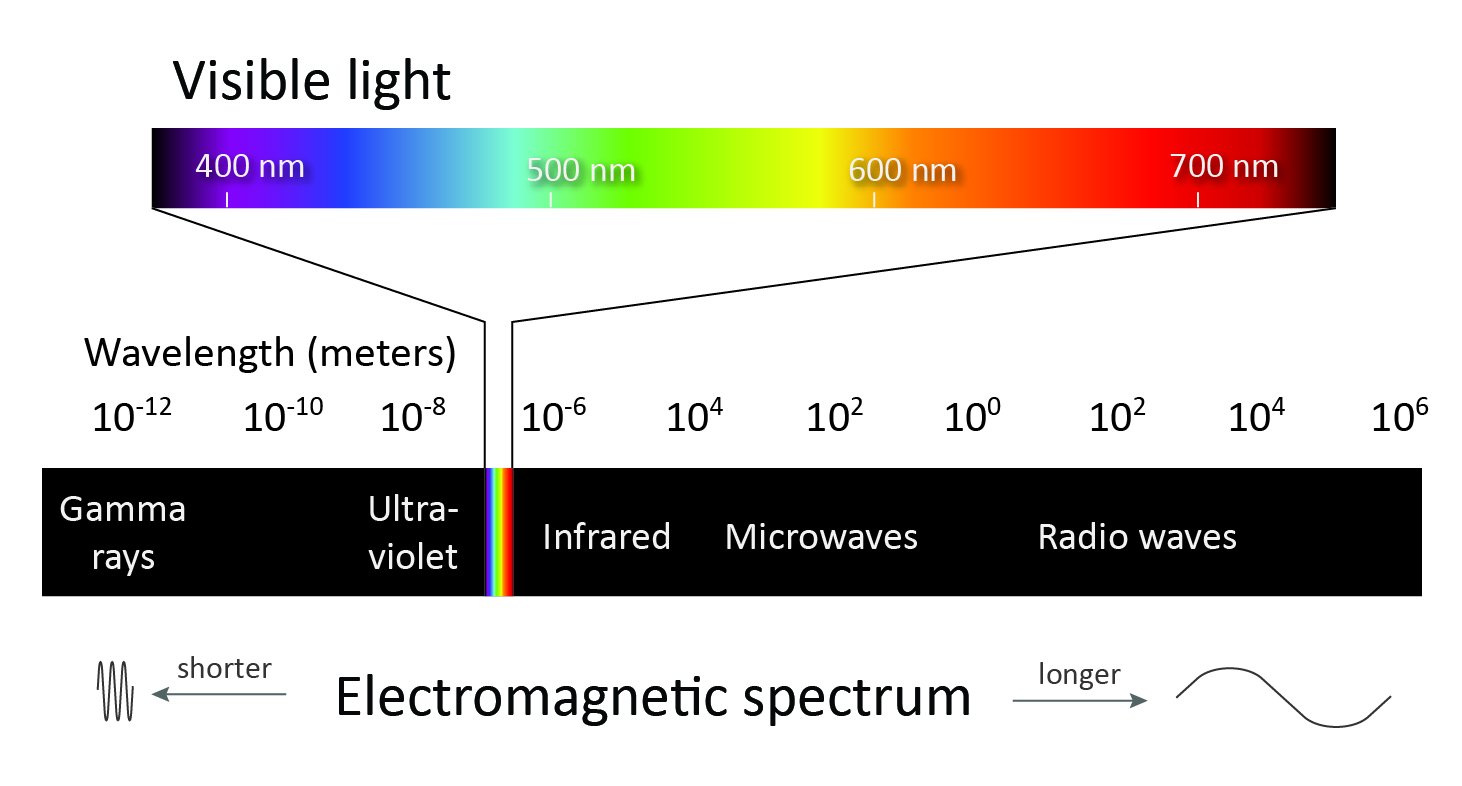
The visible light spectrum is the segment of the electromagnetic spectrum that the human eye can view. More simply, this range of wavelengths is called visible light. Typically, the human eye can detect wavelengths from 380 to 700 nanometers.Visible light has around 400 nm to 700 nm and a frequency range of around 400 THz to 800 THz. This part of the electromagnetic spectrum can be ?seen? and distinguished optically by the human eye.400 nm to 700
This part of the spectrum is called the visible light region. The visible light region ranges in wavelengths from about 380 or 400 nm to 700 or 780 nm depending on which source is used.

What is the spectrum of white light : When white light is passed through a glass prism it splits into its spectrum of colors (violet, indigo, blue, green, yellow, orange and red) and this process of white light splitting into its constituent colors is termed as dispersion.
What is the spectrum of visible and invisible light
Wavelengths of light are measured in nanometers (nm). One nanometer is a billionth of a meter. Visible light has wavelengths ranging from about 400 nanometers to 700 nanometers. Wavelengths shorter than 400 nm, or longer than 700 nm, are invisible to the human eye.
Is UV Light visible : Ultraviolet (UV) light has shorter wavelengths than visible light. Although UV waves are invisible to the human eye, some insects, such as bumblebees, can see them. This is similar to how a dog can hear the sound of a whistle just outside the hearing range of humans.
Visible light is one way energy moves around. Light waves are the result of vibrations of electric and magnetic fields, and are thus a form of electromagnetic (EM) radiation.

Light with wavelengths in a range of approximately 400 to 800 nm is referred to as "visible light" and is the light that we humans can see with the naked eye.
What color does not reflect light
And if an object does not reflect any light, we call it black. Black objects absorb all the light that falls on them.They also observe other kinds of light that eyes cannot see. This invisible light includes radio waves, microwaves, infrared light, ultraviolet light, X rays, and gamma rays. All light, whether visible or invisible, is a kind of wave.That is the reason; this region of the electromagnetic spectrum is called a visible spectrum or colour spectrum. It consists of 7 colour mainly; violet, blue, green, yellow, orange, and red. Violet colour has the shortest wavelength and red has the longest wavelength value.
Most of the risks associated with excessive exposure to sunlight (sunburn, eye irritation and cancers) are a result of UV-B wavelengths. Because UV flashlights emitting at wavelengths 365 nm or higher are emitting in the UV-A range, they can be thought of as being less harmful than the UV-B wavelengths.
Why can’t humans see UV light : cMost humans cannot see ultraviolet light because it has a shorter wavelength than violet light, putting it outside of the visible spectrum.
Is visible light high or low wavelength : The visible spectrum ranges from approximately 400 nanometers to 700 nanometers. A nanometer (nm) is 10^-9 meters, or one billionth of a meter, so visible light waves are extremely small. These wavelengths correspond to frequencies in the range of 750 terahertz to 429 terahertz.
Is visible light higher energy than UV
Ultraviolet radiation carries more energy and infrared radiation less energy than visible light.

Although our visual system can paint a vibrant portrait of the world, its palette of colors is actually quite limited, as we only see between 390 to 750 nm of the full electromagnetic spectrum while the remaining trillion wavelengths escape our view.A typical, healthy human eye will respond to wavelengths from about 400nm to 750nm. Different wavelengths indicate colors in the visible spectrum ranging from violet 400nm to deep red color 750nm with a significant sensitivity peak for humans at 555nm green.
What color reflects all visible light : White objects
White objects appear white because they reflect all colours. Black objects absorb all colours so no light is reflected.