


Antwort Is Keras or PyTorch better? Weitere Antworten – Is PyTorch better than Keras

PyTorch is often preferred by researchers due to its flexibility and control, while Keras is favored by developers for its simplicity and plug-and-play qualities. Speed and debugging. PyTorch is generally faster and provides superior debugging capabilities compared to Keras. Tutorials and small datasets.PyTorch is ideal for research and small-scale projects prioritizing flexibility, experimentation and quick editing capabilities for models. TensorFlow is ideal for large-scale projects and production environments that require high-performance and scalable models.You can also use Keras as a low-level cross-framework language to develop custom components such as layers, models, or metrics that can be used in native workflows in JAX, TensorFlow, or PyTorch — with one codebase.

What is the disadvantage of PyTorch : The main disadvantage of PyTorch is that it can be difficult for beginners to learn and use. It also does not have as much documentation and support resources as other deep learning frameworks, such as TensorFlow.
Is Keras easier than PyTorch
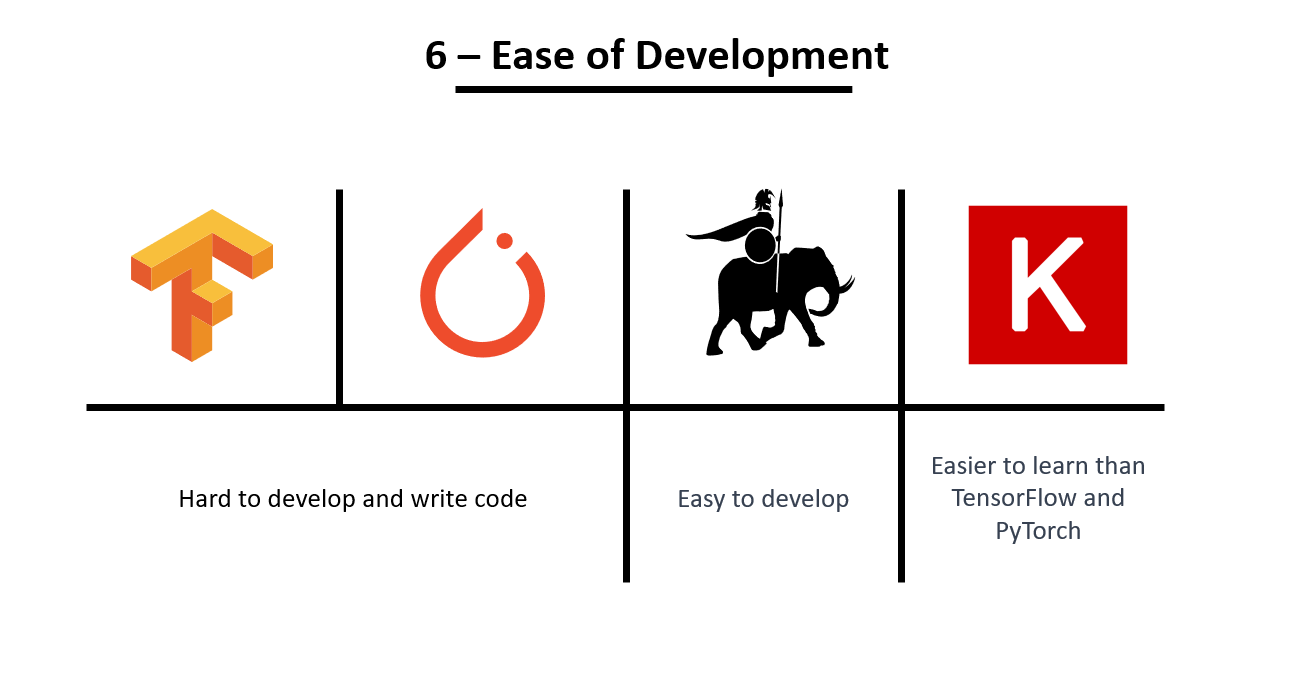
Keras has a high level of API as it is capable on running on top of the other frameworks. So it is easier to use and less code are needed. PyTorch has a low level API and hence it becomes little difficult to use and more code is required for the similar task but it gives better control to the programmer.
Is TensorFlow losing to PyTorch : PyTorch has made improvements to support distributed training and scalability. It provides tools to help you train deep learning models on multiple GPUs and even across multiple machines. But TensorFlow still holds the lead in deploying large-scale models in production.
Both provide high-level APIs used for easily building and training models, but Keras is more user-friendly because it's built-in Python.
While TensorFlow is used in Google search and by Uber, Pytorch powers OpenAI's ChatGPT and Tesla's autopilot. Choosing between these two frameworks is a common challenge for developers. If you're in this position, in this article we'll compare TensorFlow and PyTorch to help you make an informed choice.
Is Keras still popular
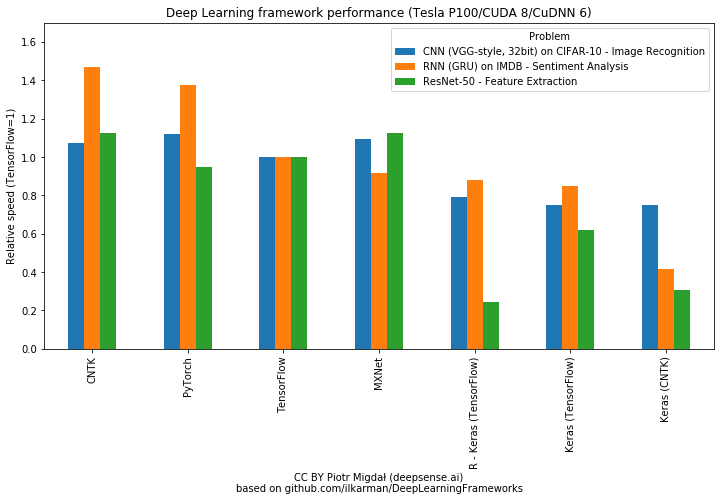
Although both these frameworks are very popular but still if we compare then Keras is much more popular than PyTorch.OpenAI uses PyTorch, which was developed at FAIR. PyTorch 2.0 uses the Triton back-end compiler which was developed at OpenAI. OpenAI use transformers and RLHF which originated at Google & DeepMind.On the other hand, Keras offers ease of experimentation being a high-level API, whereas gains in computational efficiency of higher-performing frameworks such as PyTorch will in most cases be outweighed by the fast development environment. So as far as training speed is concerned, PyTorch outperforms Keras.
PyTorch Examples and Applications
Due to its strong offering, PyTorch is the go-to framework in research and has many applications in industry. Tesla uses PyTorch for Autopilot, their self-driving technology.
Is ChatGPT built on PyTorch : I'll start: – AI research runs on PyTorch. – ChatGPT was built with PyTorch.
Does Netflix use Keras : Applications of Keras
Keras is also used for distributed training of deep learning models. Keras is used by companies such as Netflix, Yelp, Uber, etc.
Is ChatGPT written in PyTorch
ChatGPT is built on top of PyTorch, which provides the core functionality for training and running the GPT-3.5 model.
Tesla uses PyTorch for Autopilot, their self-driving technology. The company uses PyTorch to train networks to complete tasks for their computer vision applications, including object detection and depth modeling.Key Takeaways. PyTorch vs TensorFlow: Both are powerful frameworks with unique strengths; PyTorch is favored for research and dynamic projects, while TensorFlow excels in large-scale and production environments. Ease of Use: PyTorch offers a more intuitive, Pythonic approach, ideal for beginners and rapid prototyping.

Will PyTorch replace TensorFlow : PyTorch has made improvements to support distributed training and scalability. It provides tools to help you train deep learning models on multiple GPUs and even across multiple machines. But TensorFlow still holds the lead in deploying large-scale models in production.