


Antwort Are D minor and F major the same? Weitere Antworten – Is D minor and F major the same
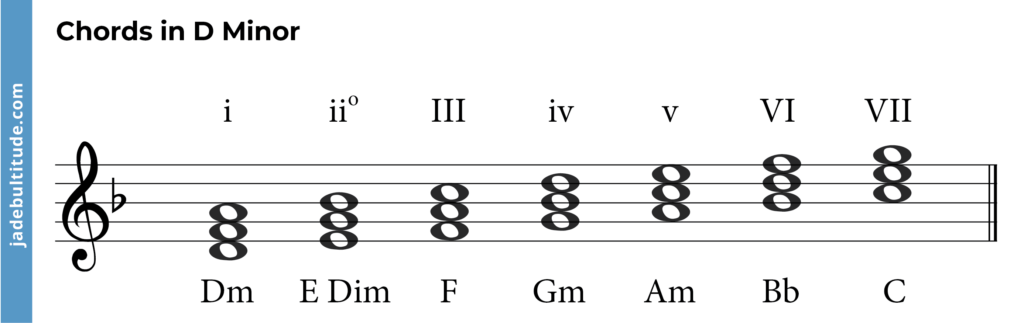
D minor is a minor scale based on D, consisting of the pitches D, E, F, G, A, B?, and C. Its key signature has one flat. Its relative major is F major and its parallel major is D major.Distinguishing on the basis of melody
To distinguish a minor key from its relative major, one can look to the first note/chord of the melody, which usually is the tonic or the dominant (fifth note); The last note/chord also tends to be the tonic.Relatives of the Closely Related Keys
- Relative minor of F: D minor.
- Relative minor of G: E minor.
- D minor scale: D, E, F, G, A, Bb, C.
- E minor scale: E, F#, G, A, B, C, D.

Is F minor the same as a major : F minor's parallel major scale starts on the same note, F, and is called F major. F minor's relative major is Ab major and has the same key signature; it uses the same notes as F minor, but starts on Ab. Another way musical keys relate to one another is through the Circle of Fifths.
What is D minor to F major
Relative Minor of F Major: The Key of D Minor
The 6th note of the F major scale is the tonic (home) note of the relative minor. That makes the relative minor of F major the key of D minor (see Figure 37 below). The note B? is in the D minor scale.
What is the saddest chord : One of the most common chords associated with sadness is the minor chord. It is made up of three notes ? the root, the minor third, and the fifth. Unlike its counterpart, the major chord, which sounds bright and uplifting, the minor chord sounds somber and melancholic.
Scale and Key Signature
The D major scale begins on D and moves up by step, returning eventually back to D. The key signature (highlighted in yellow below) for D major has two sharps: F-sharp (F#) and C-sharp (C#). This means that all Fs and Cs will be played a half-step higher in pitch as F-sharps and C-sharps.

Its direct enharmonic, G-flat major, contains the same number of flats in its key signature.
What is F major key signature
The notes of the F Major scale are F G A Bb C D E. It's key signature has 1 flat. Press play to listen to the scale.F major and D minor have the same musical notes, the difference lies in the usage. A major key, as you know will focus on the root chord which will be a major chord, while a minor key focuses on minor chord. Major chords will sound brighter than minor ones.F major's relative minor key is D minor and F major's parallel minor is F minor. The parallel major starts on the same note (F) but has a different key signature, while the relative minor key has the same key signature with 1 flat. To build a relative minor, find the sixth scale degree of F major ? it's the note D.
D to F# is a major 3rd. F is a half step lower. D to F is a Minor 3rd.
Is F-sharp in D major : Scale and Key Signature
The key signature (highlighted in yellow below) for D major has two sharps: F-sharp (F#) and C-sharp (C#). This means that all Fs and Cs will be played a half-step higher in pitch as F-sharps and C-sharps. The notes of the scale are: D, E, F#, G, A, B, C#.
Why is D minor so sad : This so-called ?flatted third? is closer to the root note, and the distance from the major third is thought to create peripheral dissonance and a jarring discomfort in the listener's ear. And by making the note go a half-step down rather than up, it creates a ?feeling down? directional emotion.
What’s the devil’s chord
I don't know if that's true um or they kick you out so. What. Else it's very dissonant. This makes a diminished seventh chord if you had two tritones.
The relative minor of F sharp major is D sharp minor. F sharp is the enharmonic equivalent of Gb. The G flat major scale makes use of the same keys on the piano and sounds the same as the F# major scale. The difference is the names of the notes.Notes of the F# melodic minor scale ascending: F?, G?, A, B, C?, D?, E?, F?.
Why is F# so popular : F# has a powerful type system which prevents many common errors such as null reference exceptions. Values are immutable by default, which prevents a large class of errors.