


Antwort What is a Polish greeting? Weitere Antworten – How do you greet someone in Polish

That probably doesn't help pronouncing it chest. Okay chest is how you say it chest. And that's how you spell it c-z-e-s-c chest is how most people say hi hello in Polish in Poland chest.Hey all these GRE are very informal. And we should only use them with friends or close relatives.Hello
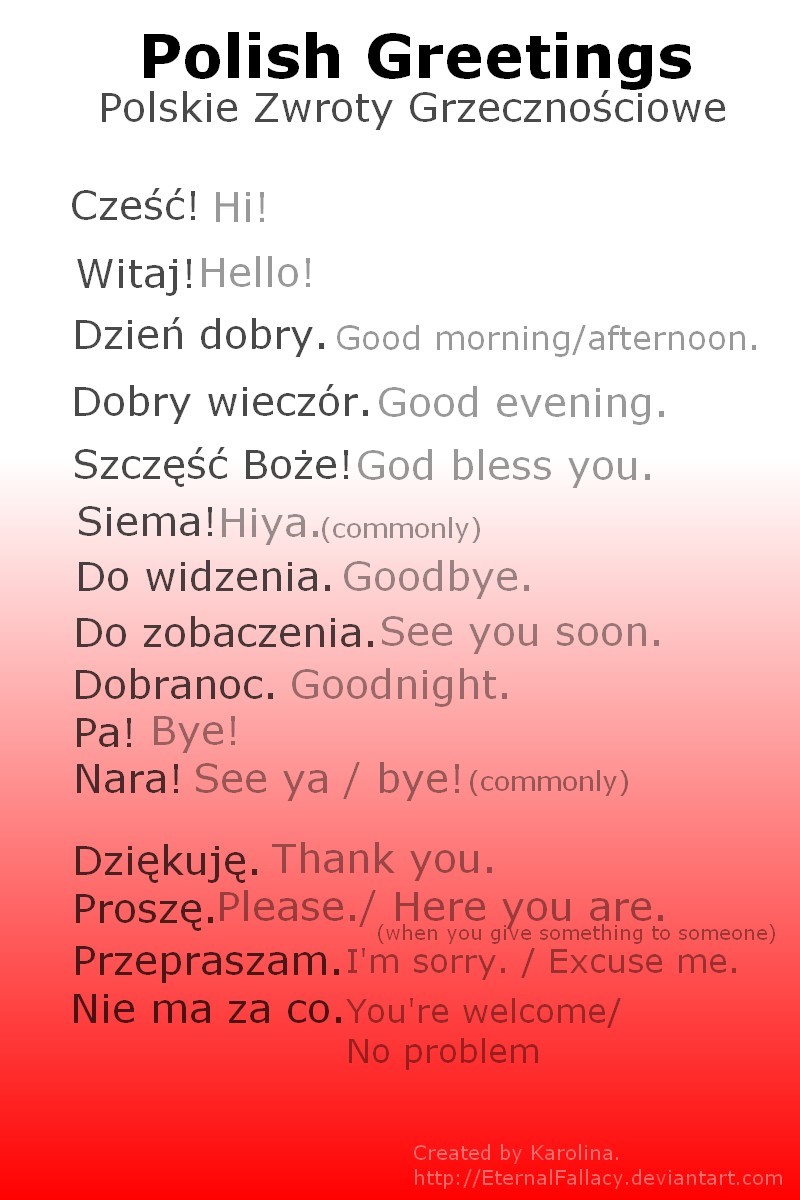
Cze?? means ?Hi? or ?Hello.? Another informal greeting is Siema! This phrase also means ?Hi,? but it is only used by young people. Besides, Hej! Hej! is very common.
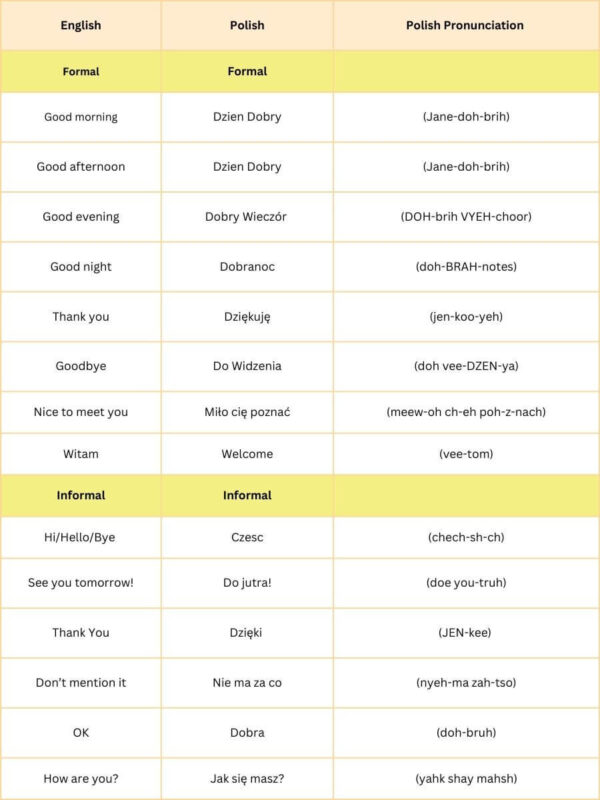
Do Polish people say please and thank you : Prosz? – please / here you are (PROH-sheh) pronunciation (help?info) Dzi?kuj? – thank you (jen-KOO-yeh)
What are some common Polish phrases
What are some useful Polish phrases to learn for beginners
- Good day = Dzie? dobry.
- My name is = Nazywam si?
- Please = Prosz?
- Thank you = Dzi?kuj?
- How are you = Jak si? masz
- I'm sorry = Przykro mi.
What is a famous Polish saying : Bez pracy nie ma ko?aczy.
Literal translation: ?Without work, there's no kalach [cake].? English equivalent: ?No pain, no gain.? It's not surprising that both Polish and English have a proverb on the importance of hard work. Nothing in life comes for free!
Cze??
The common verbal greetings are ?Cze??? (Hello), ?Dzien dobry? (Good day) or ?Dobry wiecz?r? (Good evening). It's generally only appropriate to address someone by their first name if they're a close friend.
ass
So, what does dupa mean in Polish Dupa in English is most accurately translated as ass. And if used as such, it is a bit vulgar, but not the worst swear word available.
Why do Polish people say tak
Why do Polish people say "tak" 'Tak' in the Polish language means 'yes'. But the word also has a meaning of 'so', 'thus'. This is similar to Latin 'sic', which subsequently became 'si' ('yes') in numerous Romance languages.
- Always greet people as Pan / Pani unless and until they say ?let's call each other by our first names? – calling someone from the first go as ?Marcin? rather than ?Pan D?ugowski?
- Never point with your finger at someone or at something – you use the whole palm of your hand to do so.
When you are sharing a glass of wine or beer or vodka. In Poland polish pronunciation cheers in Polish is pronounced as dravier also meaning for health Nostrovia. To your health.

'Cze??', pronounced chesht, is a common way to greet others in Poland. Alternatively, you can use a more informal greeting in the form of 'hej', pronounced hey. This is more appropriate for friends rather than business meetings. In Polish, the combination of 'Cz' sounds like ch and '??' makes a sht noise.
What is Supa Dupa : SupaDupa is an online store builder which allows users to create e-commerce stores, originally targeting the creative sector.
Is it Dupa or Doopa : Polite way: pupa (pronounced: poopa) Colloquial way (crude, would be considered impolite by your mom's friend, but more commonly used on the street): dupa (pronounced: doopa)
Is Tak Polish for yes
Polish for yes is simply TAK. It's pronounced as it is written and the gesture that goes with it is the nodding of the head (optional, of course).

Polish Culture
The common greeting is to shake hands while holding direct eye contact. People usually shake women's hands first before addressing any men present. Older women are greeted before other girls. Men (especially seniors) may look to kiss a woman on the hand.What are some useful Polish phrases to learn for beginners
- Good day = Dzie? dobry.
- My name is = Nazywam si?
- Please = Prosz?
- Thank you = Dzi?kuj?
- How are you = Jak si? masz
- I'm sorry = Przykro mi.
How do you greet a Polish girl : Men may kiss the cheeks of their relatives or their female family members' long-term boyfriend/husband. The common verbal greetings are ?Cze??? (Hello), ?Dzien dobry? (Good day) or ?Dobry wiecz?r? (Good evening). It's generally only appropriate to address someone by their first name if they're a close friend.